 Sunreach
Explainers · Updated
Why sunrise time isn't when the sun reaches you
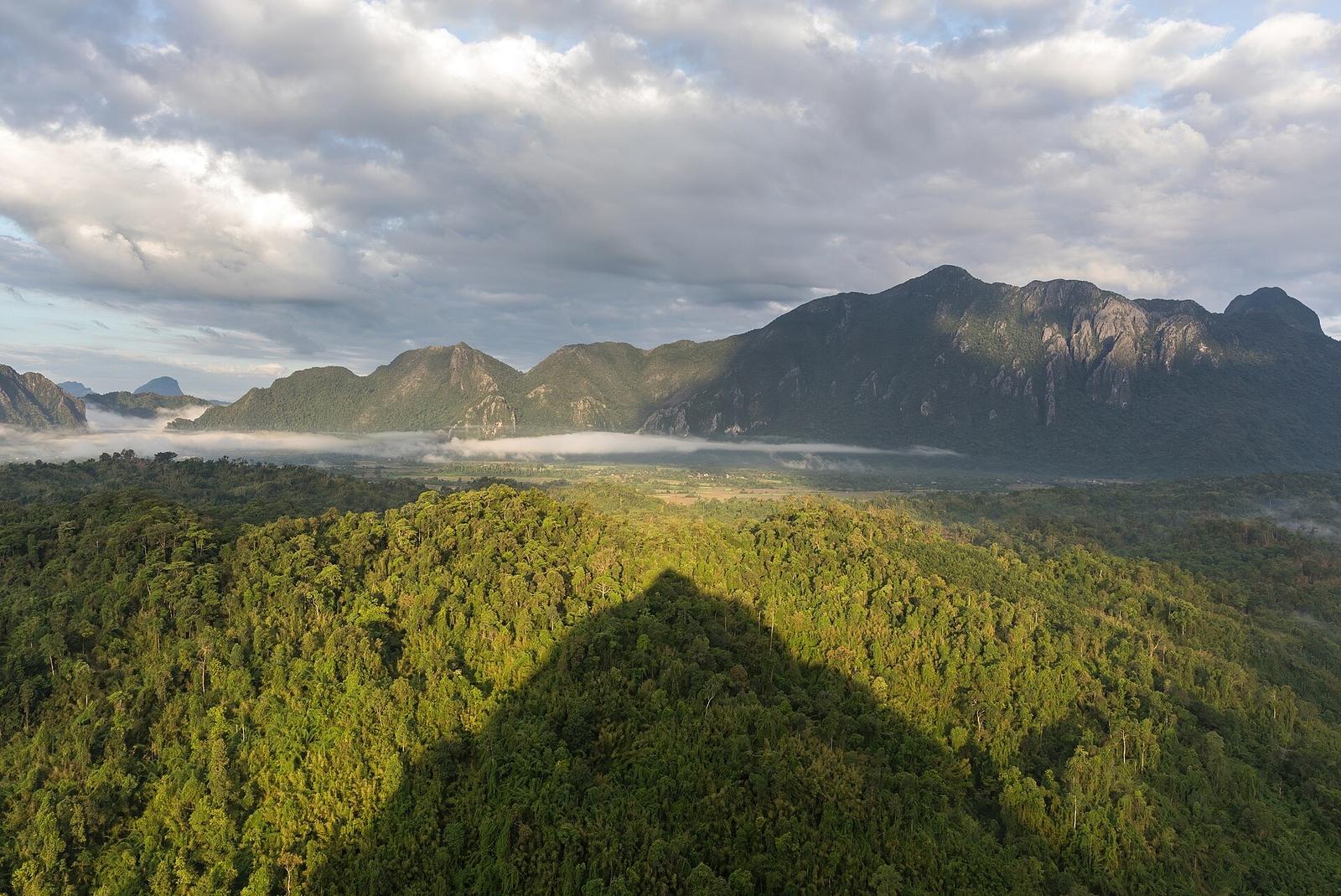
The sunrise time in a weather app is the moment the top of the sun crosses a flat, sea-level horizon; in a valley the sun reaches you only when it climbs above the ridge in its direction. In Bovec, Slovenia, on 18 October 2026, that was 08:34 instead of 07:27, 1 h 7 min later.
Sunreach is a 3D and AR sun tracker for iPhone and iPad, coming soon to the App Store. This guide describes the current app; planned upgrades are listed separately. Terrain coverage varies by location.
What does the official sunrise time mean?
Official sunrise is the instant the sun's upper edge appears on a flat horizon, which happens when the centre of the sun is 0.833° below it: 0.567° for atmospheric refraction plus 0.267° for the sun's radius. Mountains, trees and buildings are not part of the definition.
This is the definition used by the U.S. Naval Observatory, the NOAA Solar Calculator and practically every sunrise table, weather app and phone widget. Photo planners use it too: The Photographer's Ephemeris says its rise and set times follow the standard definitions and that the moment you actually see the sun "can be affected by the surrounding terrain" (TPE help).
| Event | Sun's centre (true altitude) |
|---|---|
| Sunrise / sunset (flat horizon) | −0.833° |
| Golden hour | −4° to +6° |
| Blue hour | −6° to −4° |
| Civil twilight ends / begins | −6° |
When does the sun actually reach you?
Direct sun reaches a spot when any part of the sun's disc is higher than the skyline in the sun's direction. If the ridge to the south-east stands 10° above the horizon, a winter sunrise in the south-east reaches you only when the sun has climbed past 10°.
So the real question is the skyline: how high the terrain stands in every direction as seen from the spot, from your eye height. Sunreach computes it from elevation data, marching outwards from 1.7 m above the ground in 720 directions (every 0.5°) out to 25 km, with the Earth's curvature and terrain refraction. Then it follows the sun every 30 seconds and notes when its upper edge is above that line. The Bovec skyline and sun paths show what this looks like.
Sunreach computes this for any spot on Earth, from the real terrain around it. Get the app ↓
How much later is sunrise in a valley?
At mid-latitudes each degree of skyline delays the morning sun by roughly 7–8 minutes, so a 10° ridge costs over an hour. The farther from the equator, the more slowly the sun climbs and the more minutes each degree costs.
In Bovec (46° N) the first sun on 21 December arrives at 08:52, when the sun is already 8° up; the flat sunrise is 07:46. On 21 June it is 06:18 at 8.8° against 05:13. The time the sun needs to climb the first 5° above a flat horizon, from the same engine:
| Place | 20 March | 21 June | 21 December |
|---|---|---|---|
| Singapore (1° N) | 23 min | 25 min | 25 min |
| Los Angeles (34° N) | 27 min | 31 min | 32 min |
| Ljubljana (46° N) | 33 min | 40 min | 42 min |
| London (52° N) | 37 min | 46 min | 51 min |
| Oslo (60° N) | 46 min | 69 min | 92 min |
| Reykjavík (64° N) | 53 min | 103 min | never (stays below 5°) |
Near the equator the sun rises almost vertically; at high latitudes in winter it slides along the horizon, so a small hill can hide it for a long time. The same holds in the evening, in reverse.
Why does the delay change through the year?
Because the sun rises in a different direction every day, it meets a different part of the skyline: south-east in winter and north-east in summer at mid-northern latitudes. A gap in the ridge can make the sun arrive hours earlier for a few weeks.
The Great Soča Gorge shows it well. On 1 April 2027 the sun reaches the gorge at 09:53; by 21 April 2027 the sunrise point has moved far enough north to look along the valley and the sun arrives at 07:17. See the month-by-month table for Velika korita.
Do trees and buildings count?
They can, but Sunreach does not count them for now. Global elevation data (30–40 m) is mostly bare ground; national lidar at 1–2 m resolution also records tree crowns and roofs, so a skyline built from it can include the forest edge or the house across the street.
At Velika korita, with 2 m lidar from the Slovenian environment agency, the sun reached the open ground on 18 October 2026 10:29–14:52. With trees counted the same pin had no direct sun at all, because it stands under a 6.6 m tree crown. Sunreach uses bare-ground lidar in supported countries and says which terrain each answer comes from, so check trees and walls close to your spot on site.
How do I find the real sun time for my spot?
You need the height of the skyline in the sun's direction and the sun's position through the day. Measure the skyline on site (a clinometer app, or roughly 10° per fist at arm's length), or let software compute it from terrain data.
Tools that do this from terrain: Sunreach (times for a point, 40 m everywhere, 2 m lidar in many European countries and the USA), The Photographer's Ephemeris (line of sight to see whether the sun clears a ridge), PeakVisor's Panorama 3D (sun times from the skyline at a point) and ShadeMap (shadows over an area). The comparison of sun position apps lists what each one does.
Frequently asked questions
Is sunrise earlier on a mountain top?
Yes. From a summit you look down to a horizon below you (about 1.3° lower from 2,000 m), so the sun appears earlier than the published time, roughly ten minutes at mid-latitudes, and sets later.
Do weather apps account for mountains in sunrise times?
No. Weather apps, phone widgets and sunrise tables use the flat-horizon definition (the sun's centre 0.833° below a sea-level horizon). Terrain-aware times need a skyline model of the spot.
Why is it light before the sun reaches the valley?
Twilight. The sky is lit as soon as the sun is less than about 6° below the horizon (civil twilight), and sunlit peaks reflect light into the valley, long before direct sun reaches the floor.
How long is the delay in a deep valley?
It depends on the ridge height and the season. In Bovec it is 1 h 6 min on 21 December; in the Great Soča Gorge 7 km away the sun arrives 2 h 29 min after sunrise.
Sources
Ask AI about this article: ChatGPT · Perplexity · Claude · Google AI Mode