 Sunreach
Explainers · Updated
What time is the aurora strongest? Magnetic midnight, place by place
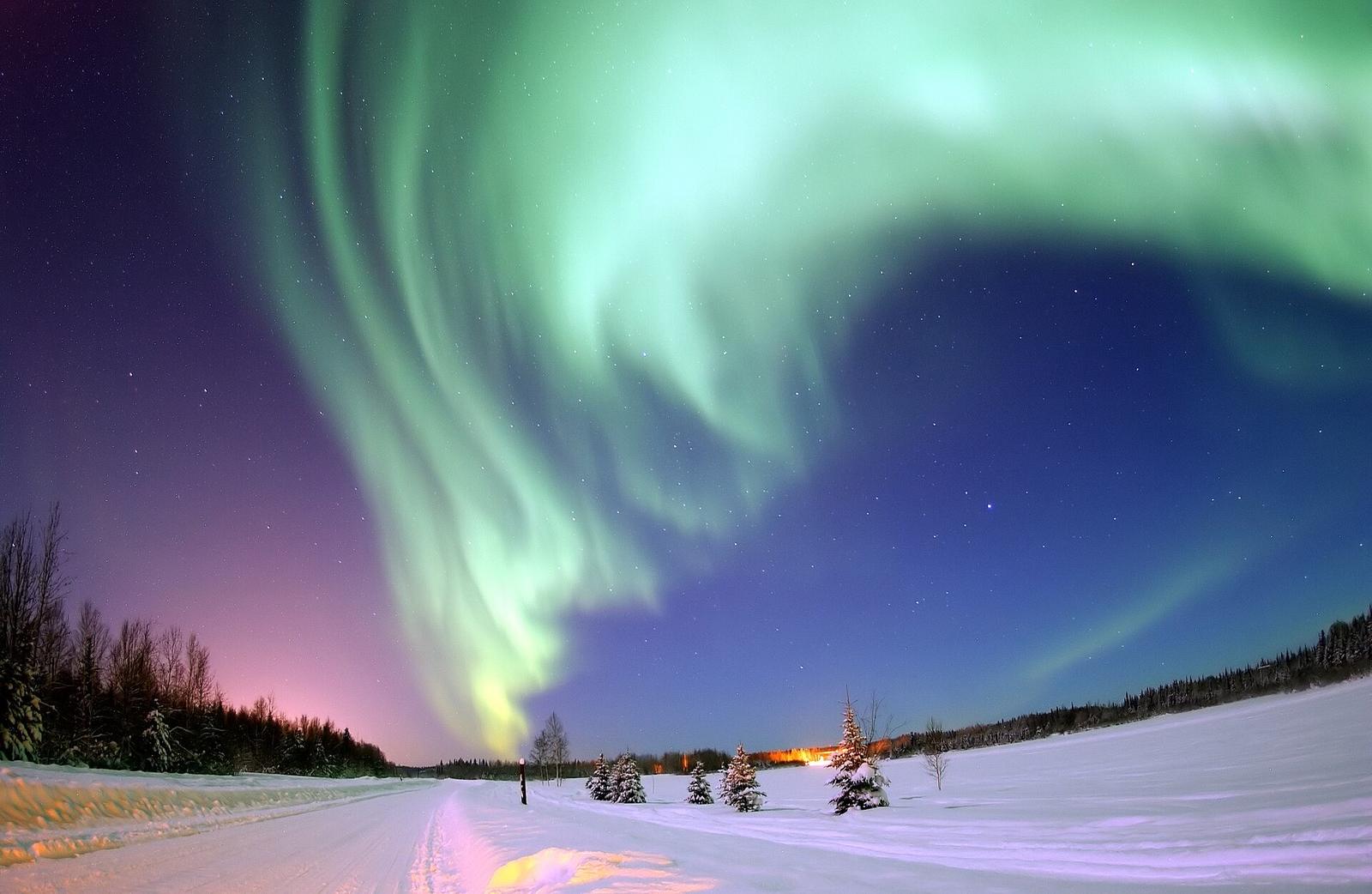
The aurora oval stays lined up with the Sun while the Earth turns under it, so it reaches furthest toward the equator near magnetic midnight and pulls back in the evening and more toward dawn. Near the edge of the oval, that hour decides whether a given Kp is enough.
Sunreach is a 3D and AR sun tracker for iPhone and iPad, coming soon to the App Store. This guide describes the current app; planned upgrades are listed separately. Terrain coverage varies by location.
What time is the aurora strongest?
Usually within an hour or two of magnetic midnight, when your place faces straight away from the Sun in Earth’s magnetic frame. In mid-December that is 22:20 in Tromsø, 23:28 in Edinburgh, 23:51 in New York and 01:50 in Fairbanks (local time).
Magnetic midnight differs from clock midnight because the magnetic pole sits in northern Canada, not at the geographic pole, and because time zones are wide. Sunreach works it out from the magnetic dipole and the Sun’s position for your exact spot and date.
| Place | Magnetic midnight (15 December 2026, local time) |
|---|---|
| Tromsø, Norway | 22:20 |
| Reykjavík, Iceland | 00:25 |
| Fairbanks, Alaska | 01:50 |
| Yellowknife, Canada | 02:19 |
| Edinburgh, Scotland | 23:28 |
| London, England | 23:25 |
| Berlin, Germany | 23:29 |
| New York, USA | 23:51 |
| Seattle, USA | 00:25 |
| Bovec, Slovenia | 23:38 |
| Hobart, Tasmania | 00:29 |
Daylight saving time moves the clock time an hour later in summer; the sky does not change.
How much more Kp do you need in the evening or at dawn?
Near magnetic midnight the Kp tables hold as published. Away from it the oval sits poleward, so the same place needs more: about 0.8 Kp more in the early evening and 1.8 more toward dawn, by magnetic local time.
| Magnetic local time | Extra Kp needed |
|---|---|
| 18:00 | +0.8 |
| 20:00 | +0.3 |
| 22:00 | none |
| 23:00 | none |
| 01:00 | +0.2 |
| 03:00 | +0.7 |
| 05:00 | +1.4 |
| 06:00 | +1.8 |
The dawn side pulls back further than the dusk side. That is why a Kp that is just enough at 23:00 often fades out of reach by 03:00, and why storms that peak in the afternoon (European time) are often over the Americas’ night instead. These values are a rounded fit of the oval’s measured shape (after Feldstein and Starkov’s oval); real substorms can briefly push past them.
Sunreach computes this for any spot on Earth, from the real terrain around it. Get the app ↓
Does the forecast peak at the same time?
Not necessarily: NOAA forecasts Kp in three-hour blocks for the whole planet, so the highest block can fall at your dusk or your dawn. What matters is the forecast against what your place needs at that hour.
Sunreach compares every quarter hour of your dark sky with the need at that moment: the forecast block in force, your skyline toward the pole and the oval’s position then. The “best time” it shows is where that margin is largest, which is usually close to magnetic midnight even when a higher block comes earlier. More on the need itself in what Kp you need to see the aurora.
When should you go out on an aurora night?
Be in place and dark-adapted an hour before magnetic midnight, stay until an hour or two after, and watch the solar wind: a southward magnetic field (negative Bz) that holds for 20 minutes or more often brings a substorm, the brightest and fastest part of the night.
- Dusk: a quiet arc low over the pole side is common; it can brighten suddenly.
- Magnetic midnight: substorms break up into rays and corona; the oval reaches furthest.
- After 02:00 (magnetic): patchy, pulsating aurora, faint by eye but good in a camera.
In the Sunreach app the Aurora tab’s time slider plays the next three days and shows the oval turning with the night; the night timeline in a spot’s plan puts dark hours, the Moon, the Milky Way core and the aurora window together.
Frequently asked questions
Is the aurora strongest at midnight?
Near magnetic midnight, which can be an hour or more away from clock midnight: 23:25 in London and 00:25 in Reykjavík in December.
Can you see the aurora in the early evening?
Yes, where you sit well inside the oval’s reach, or in a strong storm. Near the edge you need about 0.8 Kp more than at magnetic midnight.
Why is the aurora weaker toward dawn?
The oval is fixed toward the Sun; toward dawn your place turns to the side where it sits closer to the pole, about 1.8 Kp further away by magnetic 06:00.
Sources
Ask AI about this article: ChatGPT · Perplexity · Claude · Google AI Mode