 Sunreach
Explainers · Updated
What Kp do you need to see the aurora from your spot?
The Kp you need is set by how close you are to the auroral oval, which circles the magnetic pole, and by the skyline between you and it. On open ground a camera catches the aurora from Kp 4.9 in London and Kp 7.3 in the Slovenian Alps, while in Tromsø any Kp will do.
Sunreach is a 3D and AR sun tracker for iPhone and iPad, coming soon to the App Store. This guide describes the current app; planned upgrades are listed separately. Terrain coverage varies by location.
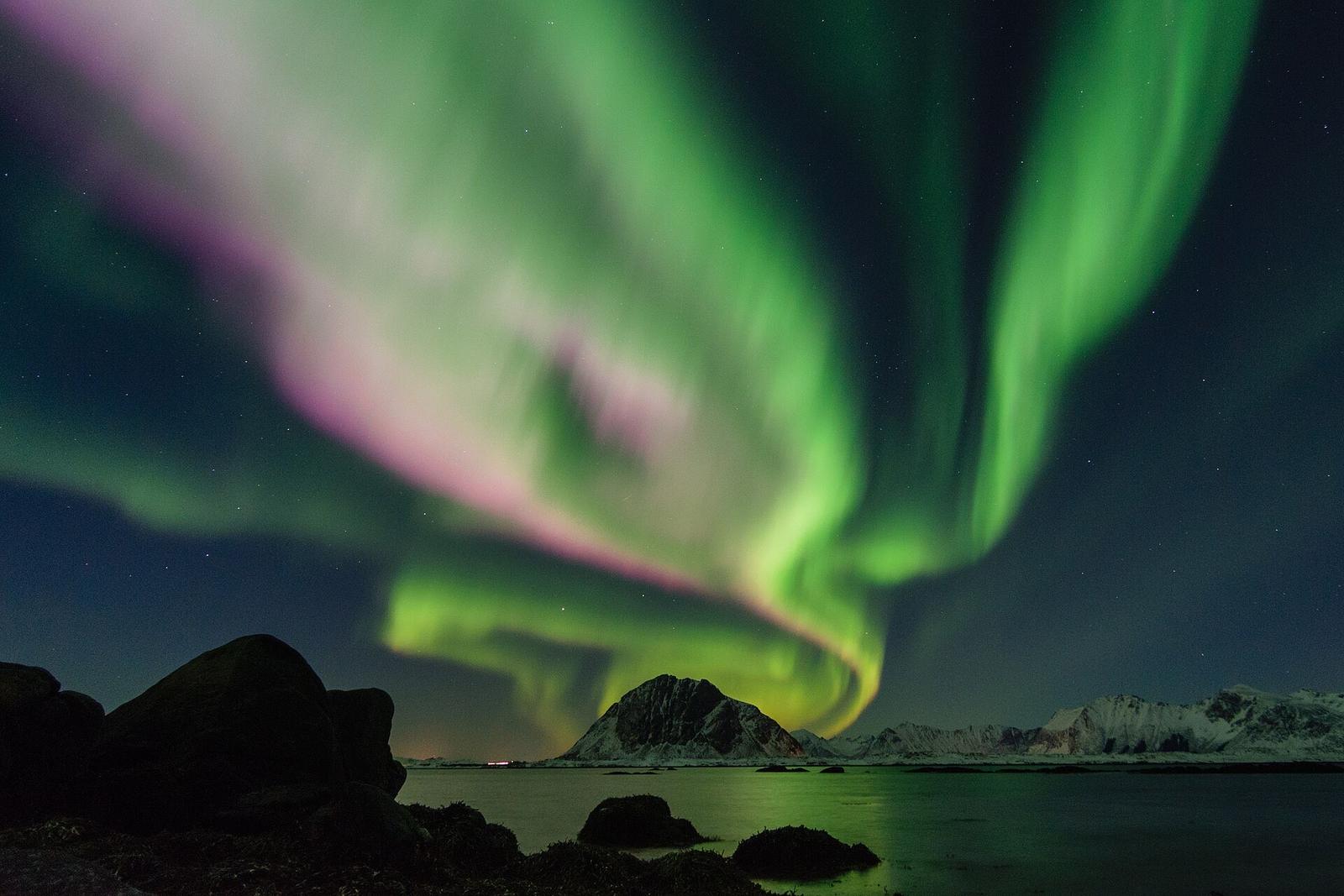
What Kp do you need to see the aurora?
It depends on your geomagnetic latitude: each Kp step moves the aurora about 227 km toward the equator. A long exposure catches it at roughly 1.5 Kp less than the eye needs.
The table gives the Kp at which the aurora shows low over the pole-side horizon on open ground, computed by Sunreach’s engine from each place’s magnetic latitude and NOAA’s Kp table. Under the oval, the need is “any”: the aurora can be overhead on a quiet night.
| Place | Magnetic latitude | Camera | Eye |
|---|---|---|---|
| Tromsø, Norway | 68° | any | any |
| Abisko, Sweden | 66° | any | any |
| Reykjavík, Iceland | 69° | any | any |
| Fairbanks, Alaska | 66° | any | any |
| Yellowknife, Canada | 69° | any | any |
| Helsinki, Finland | 58° | Kp 2.8 | Kp 4.3 |
| Oslo, Norway | 60° | Kp 1.8 | Kp 3.3 |
| Edinburgh, Scotland | 58° | Kp 2.6 | Kp 4.1 |
| Seattle, USA | 53° | Kp 5.1 | Kp 6.6 |
| London, England | 53° | Kp 4.9 | Kp 6.4 |
| Berlin, Germany | 52° | Kp 5.5 | Kp 7 |
| New York, USA | 50° | Kp 6.6 | Kp 7 |
| Munich, Germany | 48° | Kp 7 (red) | Kp 7.8 |
| Bovec, Slovenia | 46° | Kp 7.3 (red) | Kp 8.8 |
| Rome, Italy | 42° | beyond Kp 9 (red) | beyond Kp 9 |
| Hobart, Tasmania | 50° | Kp 6.8 | Kp 7.1 |
| Queenstown, New Zealand | 49° | Kp 7 (red) | Kp 7.5 |
Kp runs from 0 to 9 and is measured every three hours; 5 and up is a geomagnetic storm (G1 to G5). Values above 9 mean only a once-in-decades storm reaches that far.
Why does your skyline change the Kp you need?
The aurora stands highest overhead and sinks toward the horizon the farther away it is. About 500 km off, its top is roughly 20° up, so a mountain wall higher than that toward the pole hides it unless a stronger storm brings it closer.
Most horizons cost nothing: a 10° ridge is below the aurora’s top. A valley with a steep wall to the north is different. Sunreach reads the real skyline of your spot toward the magnetic pole from terrain (2 m lidar where it exists), finds the lowest gap that is wide enough, and adds the Kp it costs. It also names the peaks the aurora would rise over.
The same terrain logic is behind why sunrise is not when the sun reaches you.
Sunreach computes this for any spot on Earth, from the real terrain around it. Get the app ↓
Why do big storms reach so much farther south?
Because the red glow, 200 to 400 km up, stands far above the green and stays above the horizon from much farther away. From about Kp 7 it is bright enough to see: in Bovec it lowers the need from Kp 8.5 for the green alone to Kp 7.3.
That is how Central Europe saw red and pink skies in May and October 2024. The red is faint to the eye and strong in a camera. Where only the red reaches, Sunreach says so, and in AR and 3D it draws a red glow low over the pole side instead of green curtains. Munich needs Kp 7 as a red glow; Edinburgh needs Kp 2.6 for the green.
How far ahead can the aurora be forecast?
Days ahead for a storm, an hour ahead for how good it will be. A coronal mass ejection takes one to three days to reach Earth and its arrival is forecast to within about 7 hours, but its magnetic field is only measured as it passes a spacecraft 1.5 million km away, 30 to 60 minutes before it hits.
- Now to 90 minutes: NOAA’s OVATION model maps the chance of aurora overhead from the last hour of solar wind.
- Three days: NOAA’s Kp forecast in three-hour blocks, plus storm watches.
- Five days: the WSA-ENLIL solar wind model shows fast streams and CMEs on their way.
- Four weeks: the 27-day outlook repeats the Sun’s rotation, so returning coronal holes show up, new CMEs do not.
Forecasts a day or more ahead often miss by a Kp or two. Sunreach keeps the forecasts it saw and later compares them with the Kp that came, so you can see how far to trust tonight’s number.
When in the night is the aurora strongest?
Usually within an hour or two of magnetic midnight, when your place faces straight away from the Sun in the magnetic frame: around 23:00 to 00:30 in Europe, nearer 01:00 to 02:00 in Alaska. Storms are also about twice as common around the equinoxes as around the solstices.
The sky needs to be dark too: with the Sun more than 12° below the horizon the aurora shows well; a bright Moon washes out the faint parts. Sunreach puts dark hours, the Moon, the Milky Way core and the aurora window on one timeline for your spot.
How do you plan an aurora night with Sunreach?
Open the Aurora tab: it shows the live oval, tonight’s verdict for your spot and a ranked list of places within a drive. Pick one, open its plan, and turn on aurora alerts.
- Read Tonight: the Kp your spot needs over its skyline, the forecast while it is dark, and the cloud.
- Check Where to go tonight: each spot within about 250 km with the drive, its need and when the sky is clear.
- Open the spot’s plan and its Aurora row for the peaks it would rise over and the night timeline.
- On site, AR shows where the glow would stand over your real skyline.
More on the tool: the aurora forecast in Sunreach.
Frequently asked questions
Is Kp 5 enough to see the aurora in London?
Not by eye on open ground: London needs about Kp 6.4 by eye and Kp 4.9 for a camera. At Kp 5 a long exposure toward the north from a dark spot may just catch it.
Does a camera really see more than the eye?
Yes. A 5 to 15 second exposure at ISO 1600 to 3200 records colour the eye sees only as a grey glow, worth about 1.5 Kp.
What is the difference between Kp and the OVATION map?
Kp is one global number for how disturbed Earth’s magnetic field is. OVATION maps the chance of aurora overhead, place by place, for the next 30 to 90 minutes.
Can mountains hide the aurora?
Only high ones toward the pole. The aurora’s top stands about 20° above the horizon at the edge of its reach, so a lower skyline costs nothing.
Sources
Ask AI about this article: ChatGPT · Perplexity · Claude · Google AI Mode