 Sunreach
Places · Updated
Total solar eclipse of 2 August 2027: when it happens and how long totality lasts, town by town
On Monday 2 August 2027 the Moon covers the Sun completely along a path across the Strait of Gibraltar, North Africa, Egypt and Arabia. In Tarifa totality starts at 10:45 local time and lasts 4 min 38 s; near Luxor in Egypt it lasts 6 min 20 s.
Sunreach is a 3D and AR sun tracker for iPhone and iPad, coming soon to the App Store. This guide describes the current app; planned upgrades are listed separately. Terrain coverage varies by location.
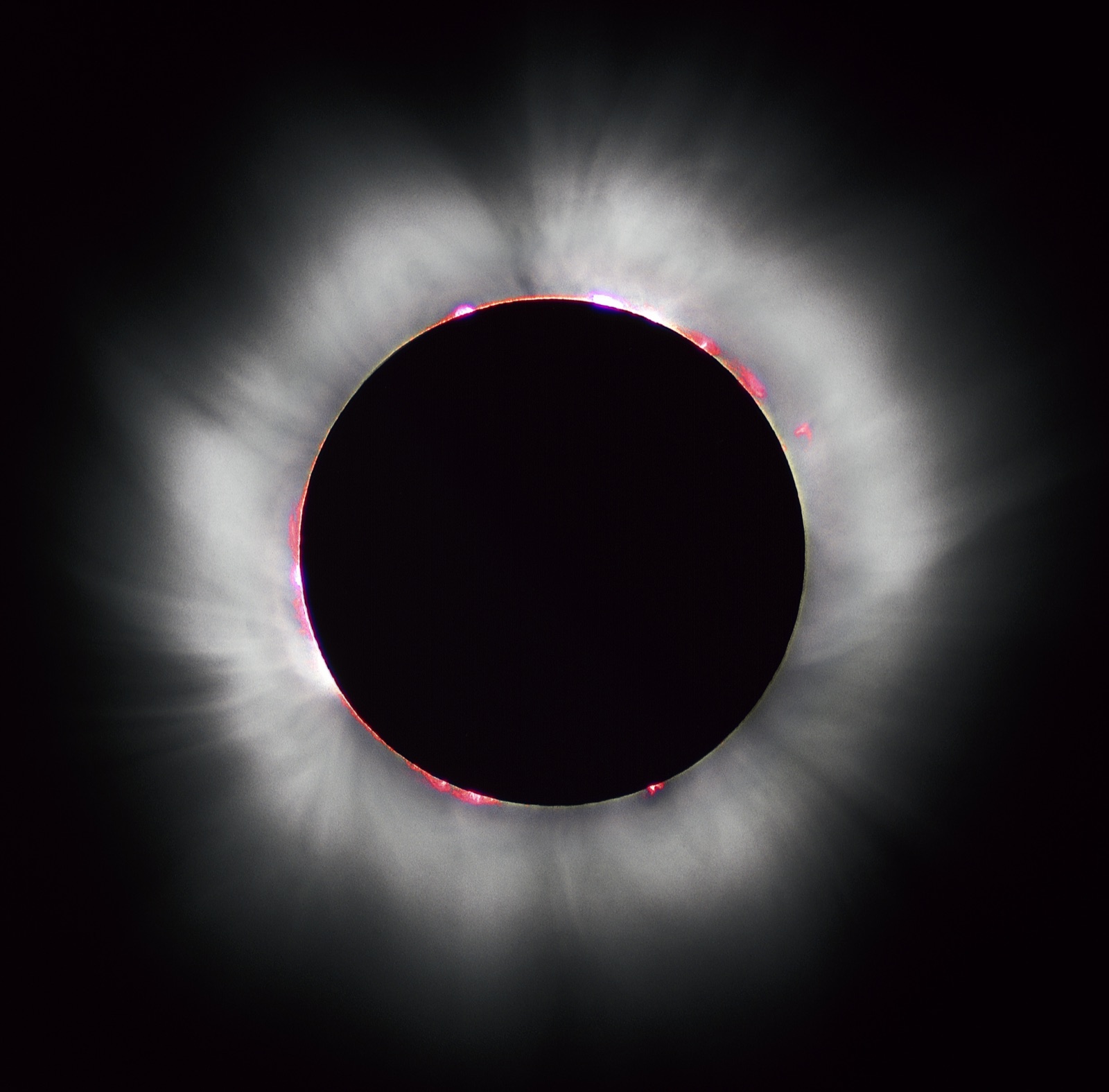
- Date
- Monday 2 August 2027
- Totality in Spain
- 10:45–10:50 CEST, up to 4 min 38 s (Tarifa)
- Longest totality
- 6 min 20 s at Luxor, 13:02 local
- Sun at totality
- 37.4°–39.4° up in the east in Spain, 81.8° in Egypt
When is the total solar eclipse of 2027?
On 2 August 2027, in the morning in Spain and Morocco (totality around 10:47 CEST in Tarifa) and around midday in Libya, Egypt and Saudi Arabia (13:05 in Luxor). The partial phases around totality last a little over an hour each in Spain and nearly an hour and a half in Egypt.
Totality, the minutes when the Sun is completely covered, for each place on the path, from Sunreach’s engine:
| Place | Totality (local time) | Length | Mid-eclipse (UTC) | Sun at mid-eclipse |
|---|---|---|---|---|
| CádizSpain | 10:45–10:48 | 2 min 52 s | 08:46 | 37.4° 95° (E) |
| Jerez de la FronteraSpain | 10:46–10:48 | 1 min 34 s | 08:47 | 37.6° 95° (E) |
| Conil de la FronteraSpain | 10:45–10:49 | 4 min 00 s | 08:46 | 37.7° 95° (E) |
| Vejer de la FronteraSpain | 10:45–10:49 | 4 min 05 s | 08:47 | 37.8° 95° (E) |
| TarifaSpain | 10:45–10:50 | 4 min 38 s | 08:47 | 38.2° 95° (E) |
| AlgecirasSpain | 10:45–10:50 | 4 min 27 s | 08:47 | 38.3° 95° (E) |
| RondaSpain | 10:48–10:49 | 1 min 14 s | 08:48 | 38.6° 96° (E) |
| MarbellaSpain | 10:47–10:50 | 3 min 16 s | 08:48 | 38.9° 96° (E) |
| MálagaSpain | 10:48–10:50 | 1 min 48 s | 08:49 | 39.4° 97° (E) |
| GibraltarGibraltar | 10:46–10:50 | 4 min 26 s | 08:47 | 38.4° 96° (E) |
| CeutaSpain | 10:45–10:50 | 4 min 48 s | 08:47 | 38.5° 95° (E) |
| TangierMorocco | 08:45–08:49 | 4 min 50 s | 08:47 | 37.9° 95° (E) |
| TetouanMorocco | 08:45–08:50 | 4 min 51 s | 08:47 | 38.4° 95° (E) |
| ChefchaouenMorocco | 08:45–08:50 | 4 min 14 s | 08:47 | 38.5° 95° (E) |
| OranAlgeria | 09:51–09:56 | 5 min 08 s | 08:53 | 43.4° 99° (E) |
| BenghaziLibya | 11:28–11:34 | 6 min 09 s | 09:30 | 67.8° 126° (SE) |
| LuxorEgypt | 13:02–13:08 | 6 min 20 s | 10:05 | 81.8° 196° (SSW) |
| JeddahSaudi Arabia | 13:22–13:28 | 5 min 55 s | 10:25 | 76.4° 256° (WSW) |
Local time from the IANA time zone database (version 2026e). It has Morocco on UTC+0 in 2027, so Tangier shows two hours earlier than Tarifa across the strait; check the local clock before you go. Times are for the town centre on a flat horizon; a few kilometres can change the length by many seconds near the edge of the path.
Where in Spain can you see totality?
Along the coast of Cádiz province and the Strait: Tarifa (4 min 38 s), Algeciras, Gibraltar, Vejer and Conil get four minutes or more, Cádiz 2 min 52 s, Málaga 1 min 48 s and Jerez 1 min 34 s. Sevilla is just outside the path: 98.4% of the Sun covered, which is still daylight, not totality.
The path’s northern edge runs between Jerez and Sevilla. Close to it, totality shortens fast: Cádiz city has 2 min 52 s, while Conil, 30 km south-east, has 4 min 00 s. If you can travel, go south toward Tarifa and the Strait; Tangier and Tetouan across the water get 4 min 50 s.
Outside the path, the eclipse is partial:
| Place | Sun covered at most | When (local) | Partial eclipse |
|---|---|---|---|
| SevillaSpain | 98.4% | 10:47 | 09:41–12:00 |
| GranadaSpain | 99.3% | 10:50 | 09:43–12:04 |
| MadridSpain | 86.4% | 10:51 | 09:45–12:03 |
| AlgiersAlgeria | 99.9% | 09:59 | 08:48–11:16 |
| TunisTunisia | 97.1% | 10:10 | 08:56–11:29 |
| CairoEgypt | 94.8% | 12:56 | 11:33–14:16 |
| HurghadaEgypt | 98.6% | 13:05 | 11:41–14:25 |
| AswanEgypt | 99.9% | 13:08 | 11:43–14:30 |
Even 98.4% is nothing like totality: the sky stays bright and the corona does not show. Aswan misses totality by a hair (99.9%).
Sunreach computes this for any spot on Earth, from the real terrain around it. Get the app ↓
Can mountains or buildings hide the eclipse?
Rarely: at totality the Sun is 37.4°–39.4° above the horizon in the east in Spain and Morocco, 43.4° in Oran and about 81.8° in Egypt, higher than almost any mountain skyline. What can hide it is something steep and close: a house across a narrow street, a cliff, the wall of a gorge.
A rule of thumb for Spain and Morocco: an obstacle to the east hides the Sun at totality if it is taller than about 0.8 times its distance from you. A 10 m building 12 m away is enough; a 1,000 m ridge 2 km away (27°) is not. In old towns with narrow lanes, like Vejer, Tarifa or Chefchaouen, stand somewhere with an open view east: a square, a beach, a rooftop or the harbour wall.
In Egypt and Saudi Arabia the Sun is nearly overhead, so almost anywhere outdoors works; shade from a wall or a palm can block it, but nothing on the horizon will. Why the skyline changes when you see the Sun explains the geometry.
Where does totality last longest?
Near Luxor in Egypt: 6 min 20 s. Benghazi gets 6 min 09 s, Jeddah 5 min 55 s, Oran 5 min 08 s, and the Strait of Gibraltar about four and a half minutes.
Totality is longest where the Sun is highest. There you are a few thousand kilometres closer to the Moon, so it looks slightly larger against the Sun, and at midday the ground turns along with the shadow instead of across it. That is why totality grows from under five minutes on the Strait to over six on the Nile. Being on the centre line matters as much as the region: along the edge of the path, totality is short wherever you are.
How do you plan your spot in Sunreach?
Pick your spot on the map and open the Eclipses card in the plan: it lists the eclipses seen from that exact point over the next ten years, with the times and how high the Sun stands above the skyline at maximum. On the day, AR draws the Sun’s position for any minute over the camera view, so you can see whether a roof or a tree is in the way.
- Pick the spot. Search a town or hold the map where you plan to stand.
- Open Eclipses in the plan. The 2 August 2027 eclipse shows with its kind and how much of the Sun is covered, the times to about half a minute, and the Sun’s height over the terrain skyline.
- Compare spots. Move the pin a few kilometres toward the centre of the path and the totality times change with it.
- Check the view where you stand. In AR, set the day and the minute of totality and look where the Sun will be.
The Eclipses card and planning other dates are part of Sunreach Pro; today and tomorrow are free.
How do you watch it safely?
Look at the partial phases only through eclipse glasses that meet ISO 12312-2, or through a proper solar filter on a camera, binoculars or telescope. Only during totality, when the Sun is completely covered, can you take them off, and they go back on the moment the first bright point of the Sun returns.
Sunglasses, smoked glass and phone screens do not protect your eyes. Binoculars and cameras need a filter on the front, never one held at the eyepiece. If you are just outside the path, as in Sevilla or Madrid, keep the glasses on the whole time: there is no safe moment without them.
What can these times not tell you?
They are clear-sky geometry for the town centre on a flat horizon. Clouds, haze and where exactly you stand decide what you see.
Egypt and Saudi Arabia in August are among the most reliably clear places on the path. Along the Strait of Gibraltar the easterly Levante wind can pile cloud against the Rock and the hills, so keep a spot a short drive away in reserve. The engine’s eclipse times agree with NASA’s published predictions to within about a quarter of a minute, and totality lengths to within a few seconds.
Frequently asked questions
Is Madrid in the path of totality?
No. In Madrid 86.4% of the Sun is covered at 10:51 CEST: a deep partial eclipse, with eclipse glasses on throughout.
Is Sevilla in the path of totality?
No, it is just north of the path: 98.4% at 10:47 CEST. Jerez de la Frontera, an hour south, gets 1 min 34 s of totality.
What time is the eclipse in Luxor?
Totality in Luxor runs 13:02–13:08 Egypt time (UTC+3), 6 min 20 s, with the Sun 81.8° up, almost overhead.
Do these times work for my exact spot?
Within a few kilometres of a listed town, roughly. Near the edge of the path the length changes quickly, so check your own point in the app or on NASA’s interactive map.
Sources
Ask AI about this article: ChatGPT · Perplexity · Claude · Google AI Mode