 Sunreach
Places · Updated
Manhattanhenge 2027: dates, times and where to stand
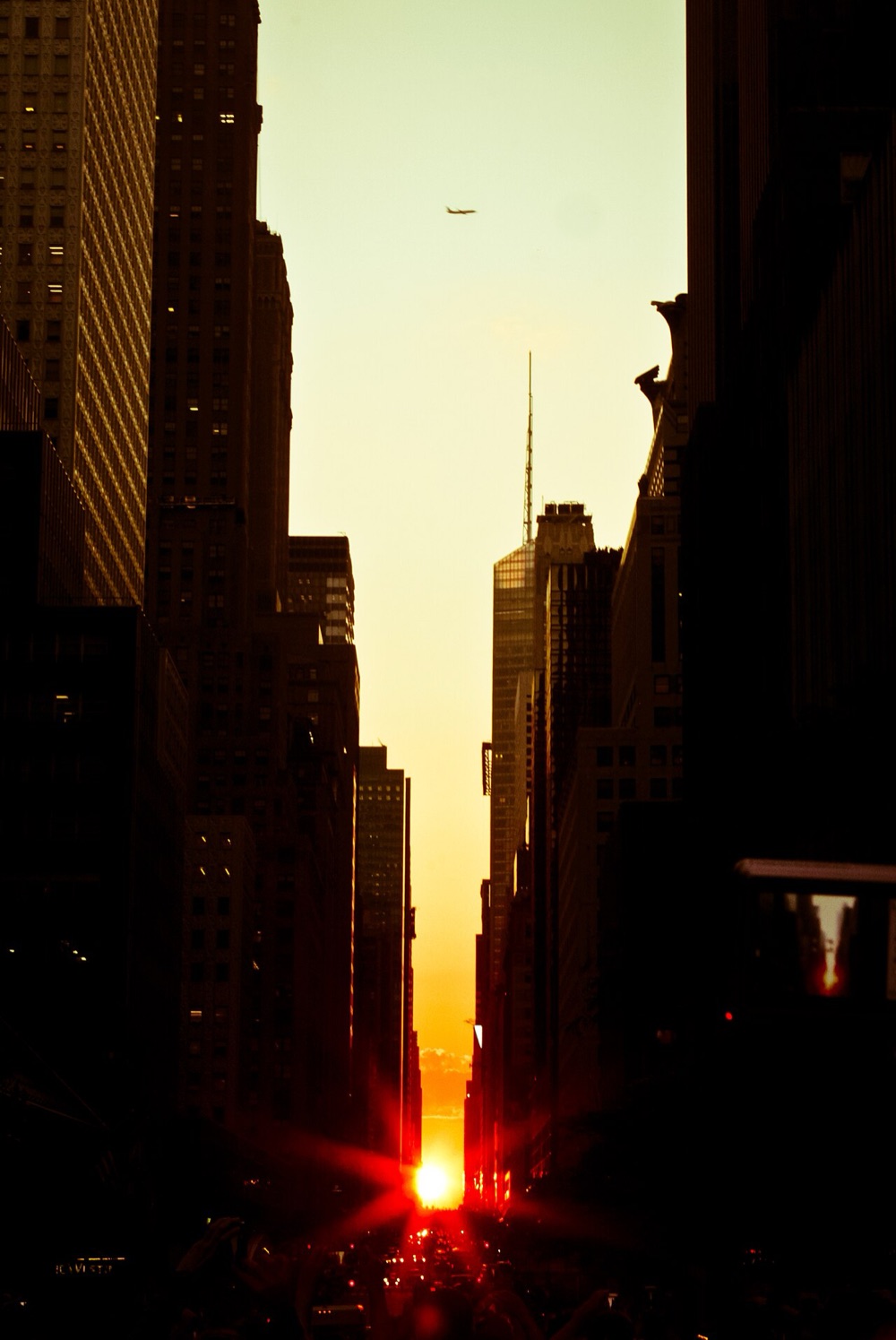
Manhattanhenge is the evening the setting sun lines up exactly with Manhattan's cross streets and fills the end of 42nd, 34th or 14th Street. In 2027 the whole sun sits on the skyline at the end of the street on 29 May and 13 July at about 20:12 and 20:20 EDT, with the half sun on 28 May and 15 July.
Sunreach is a 3D and AR sun tracker for iPhone and iPad, coming soon to the App Store. This guide describes the current app; planned upgrades are listed separately. Terrain coverage varies by location.
- Spring evenings
- 28 May (half sun) · 29 May (whole sun)
- Summer evenings
- 13 Jul (whole sun) · 15 Jul (half sun)
- Time
- 20:12 and 20:20 EDT
- Street bearing
- 299° (WNW), the Manhattan grid
When is Manhattanhenge in 2027?
On 28 May and 29 May, then 13 July and 15 July 2027. On 29 May and 13 July the whole sun sits on the skyline at the end of the street; on 28 May and 15 July it is cut in half by it.
Manhattan's streets were laid out by the Commissioners' Plan of 1811 on a grid turned about 29° from true north, so the cross streets point to 299° (WNW) at their western end. The sun only sets that far north between late May and mid July: it passes the street's bearing on the way to the summer solstice and again on the way back, and the evenings when that happens right at the skyline are Manhattanhenge.
The engine follows the sun every 30 seconds on every evening of 2027, finds the moment its centre crosses the street's bearing, and compares its height with the skyline in that direction. The rows below are the days around each date from 42nd Street, with 14th Street beside them; highlighted rows are the whole and half sun.
| 2027 | 42nd St: sun on the axis | Its lower edge | What you see | 14th Street |
|---|---|---|---|---|
| 26 May | 20:14 | −0.6° | Already set | 20:14 · Already set |
| 27 May | 20:13 | −0.4° | Less than half showing | 20:13 · Less than half showing |
| 28 May | 20:13 | −0.2° | More than half showing | 20:13 · Half sun on the skyline |
| 29 May | 20:12 | on the skyline | Whole sun above the skyline | 20:12 · More than half showing |
| 30 May | 20:12 | +0.2° | Whole sun above the skyline | 20:12 · Whole sun above the skyline |
| 31 May | 20:11 | +0.4° | Whole sun above the skyline | 20:11 · Whole sun above the skyline |
| 1 Jun | 20:11 | +0.5° | Whole sun above the skyline | 20:11 · Whole sun above the skyline |
| 10 Jul | 20:18 | +0.6° | Whole sun above the skyline | 20:18 · Whole sun above the skyline |
| 11 Jul | 20:19 | +0.4° | Whole sun above the skyline | 20:19 · Whole sun above the skyline |
| 12 Jul | 20:20 | +0.2° | Whole sun above the skyline | 20:20 · Whole sun above the skyline |
| 13 Jul | 20:20 | +0.1° | Whole sun above the skyline | 20:21 · More than half showing |
| 14 Jul | 20:21 | −0.1° | More than half showing | 20:21 · Half sun on the skyline |
| 15 Jul | 20:22 | −0.3° | Half sun on the skyline | 20:22 · Less than half showing |
| 16 Jul | 20:23 | −0.5° | Less than half showing | 20:23 · Already set |
On 14th Street the half and whole sun come out on 28 May and 30 May, then 13 Jul and 14 Jul: the skyline there is 0.5° rather than 0.4°, enough to move a date by a day.
How do these compare with the official 2026 dates?
The times agree: at the museum's own point and street bearing, the engine's 2026 times are within 1 minute of the Hayden Planetarium's on all four evenings. Which evening counts as "half" or "whole" sun differs by a day twice, because the two calculations put the horizon at slightly different heights.
The American Museum of Natural History calculates Manhattanhenge for 42nd Street at Fifth Avenue with a street bearing of 299.1°, and its astronomers describe the horizon height they assume as about a quarter to half a degree. We ran the engine for 2026 at the same corner and bearing. Its skyline there, from the ground in New Jersey, is 0.5°.
| 2026 | Museum | Engine: sun on the axis | Sun's centre vs skyline | What the engine shows |
|---|---|---|---|---|
| 28 May | Half sun, 20:14 | 20:13 | −0° | Half sun on the skyline |
| 29 May | Whole sun, 20:13 | 20:13 | +0.2° | More than half showing |
| 11 Jul | Whole sun, 20:20 | 20:20 | +0.5° | Whole sun above the skyline |
| 12 Jul | Half sun, 20:21 | 20:21 | +0.3° | Whole sun above the skyline |
On 28 May and 11 July both agree on what you see. On 29 May the engine still has the bottom of the sun just behind the New Jersey skyline, and on 12 July it has the whole sun sitting on it. Between neighbouring evenings the sun's height on the street axis changes by only about 0.2°, about the same as the uncertainty in refraction near the horizon, so a one-day difference in the labels is expected; by the engine's own definition the 2026 pairs were 28 May and 30 May, then 12 Jul and 14 Jul.
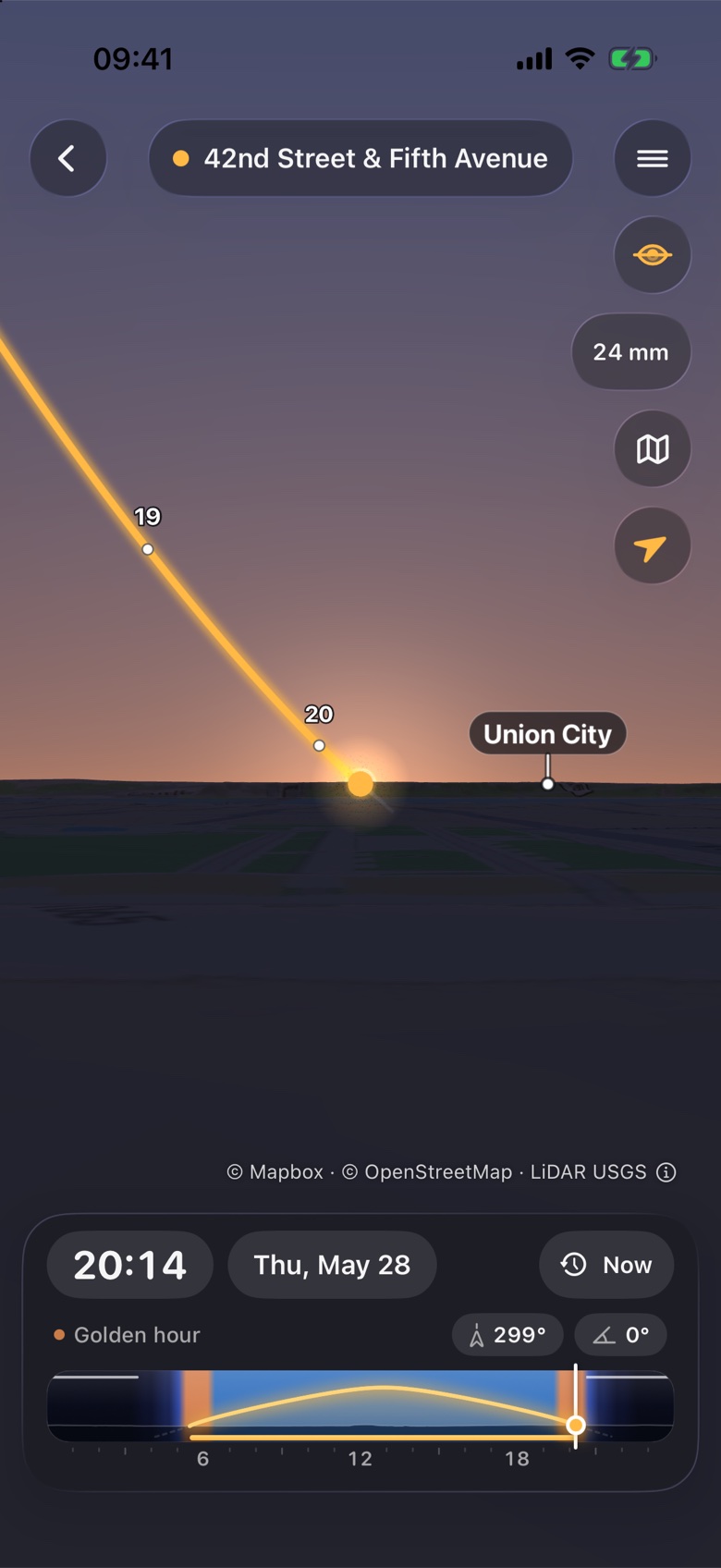
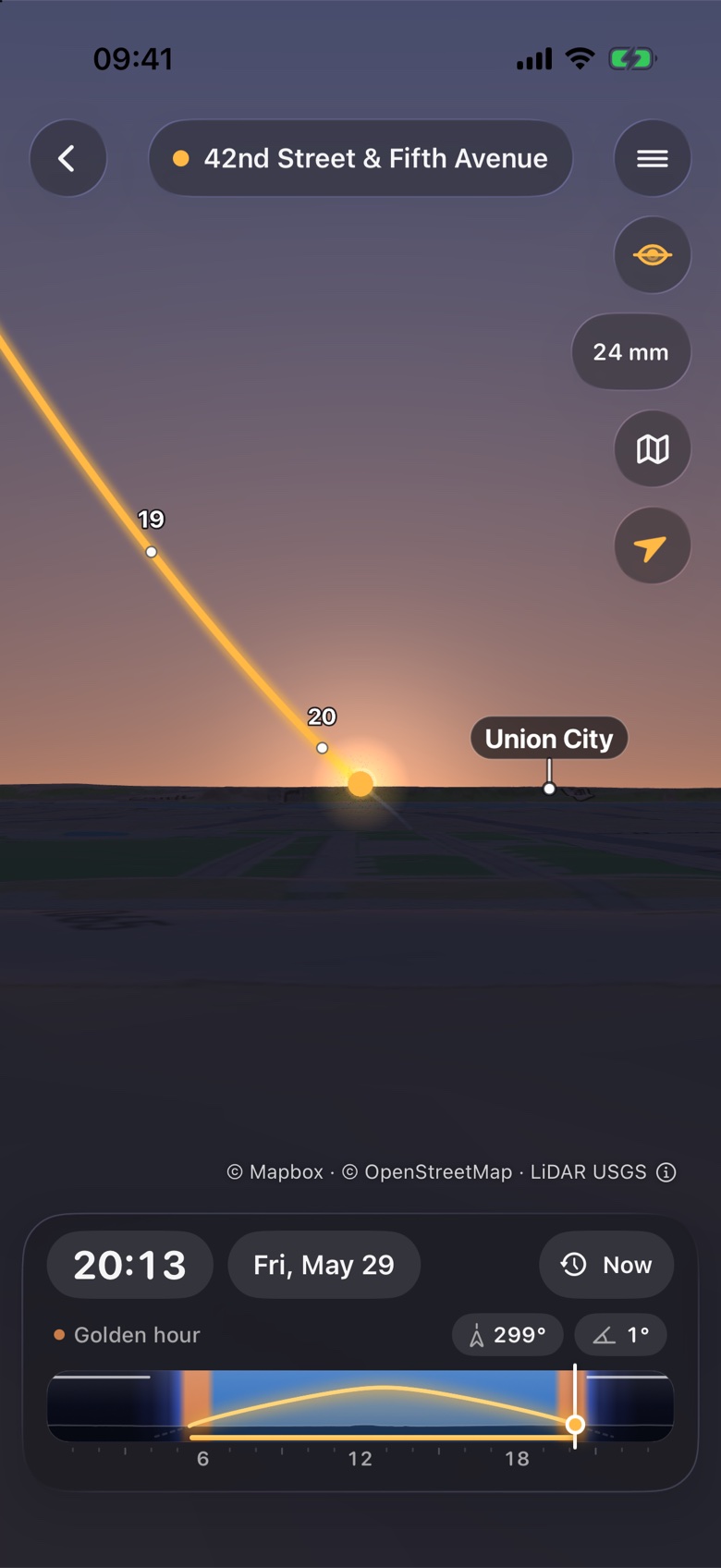
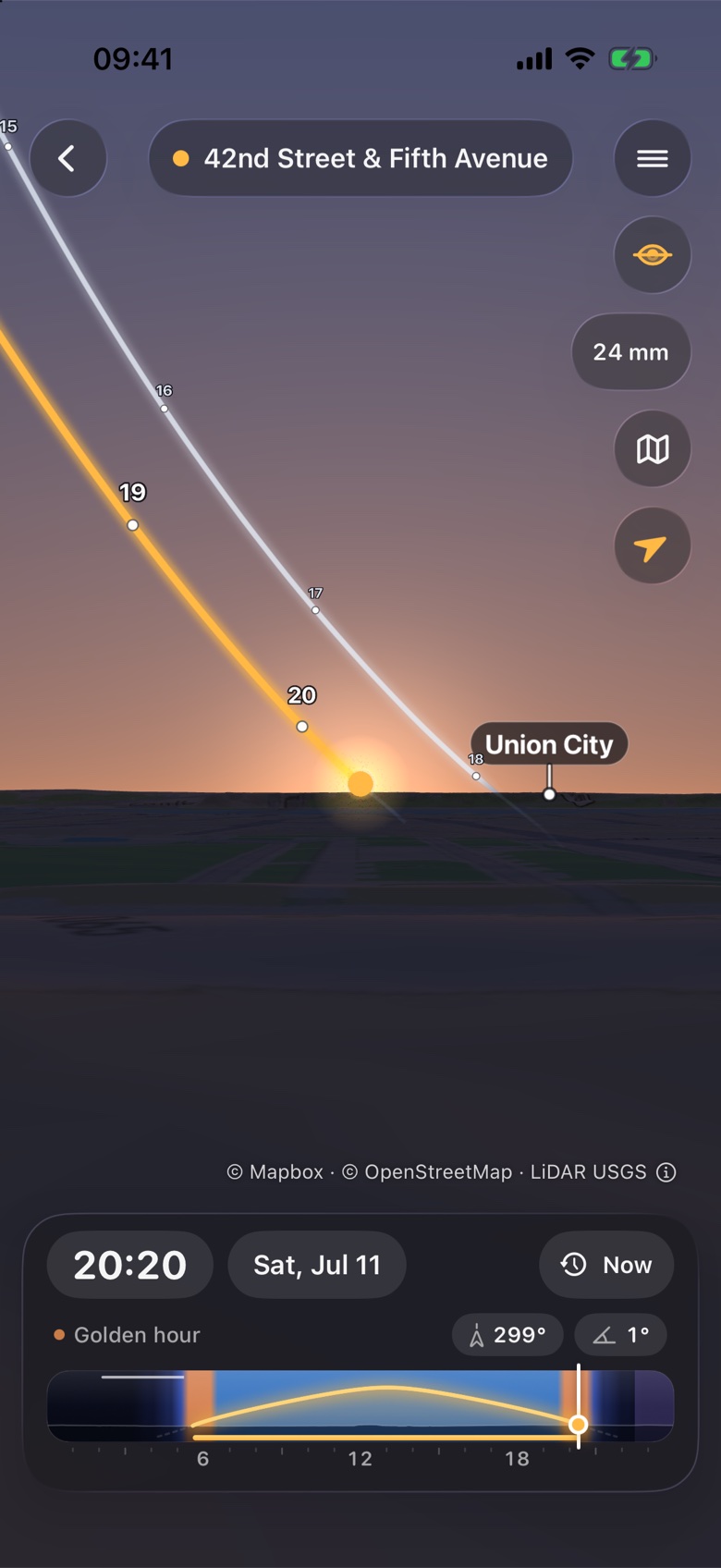
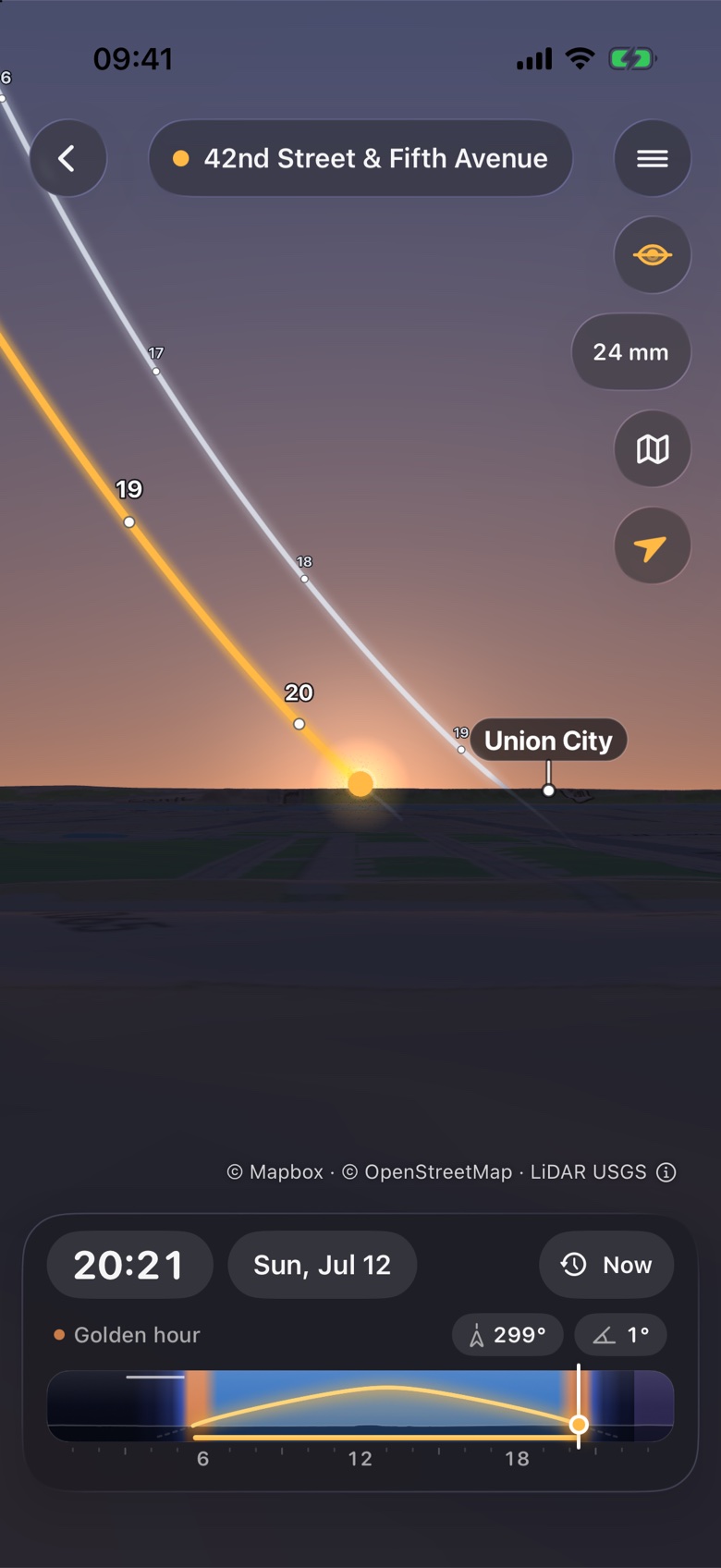
Sunreach at eye level at 42nd Street and Fifth Avenue, looking down the street at the museum's published times, with buildings turned off so the skyline is the same bare ground as in the table. App screenshots from a pre-release build.
Sunreach computes this for any spot on Earth, from the real terrain around it. Get the app ↓
What time should I be there?
Be in place 30 minutes early: on 29 May the sun reaches the street's axis at 20:12 EDT and drops behind the New Jersey skyline at 20:16, 4 min later. The flat-horizon sunset printed in tables is 20:19, 3 min after the sun has already gone from the street.
The best light is in the ten minutes before the alignment, when the sun is a deep orange ball low between the buildings and both sides of the street glow. Once it touches the skyline it is gone in about three minutes.
Where is the best place to watch Manhattanhenge?
As far east as you can on a wide cross street with a clear view across the Hudson: 14th, 23rd, 34th, 42nd and 57th Streets. The Tudor City bridge over 42nd Street, near the East River, is the classic raised viewpoint.
From the east side the street is a long, narrow canyon, and the buildings on both sides frame the sun. Standing in the roadway is dangerous; the Tudor City bridge and the wide sidewalks near the avenues are safer places to wait, and they fill up early on the whole-sun evenings. A longer lens compresses the street and makes the sun look larger against the buildings.
Is there a winter Manhattanhenge at sunrise?
Yes, looking east: the rising sun lines up with the same streets in winter, with the whole sun on the skyline on 12 January and 30 November 2027 at about 07:23 and 07:04 EST. It is much less known, because it is cold and early.
The half sun mornings are 11 January and 1 December. The skyline to the east-south-east along the streets (0.2° at 42nd Street) is even lower than the western one.
Do other cities have a "henge"?
Any city with long, straight streets has its own days. Where the streets run exactly east–west, as in much of Chicago, the sun lines up with them around the March and September equinoxes.
To find them for your own street in Sunreach, drop the pin on the street, draw the street’s bearing on the map (or aim along it at eye level in 3D) and run alignment search: it lists the evenings and mornings the sun lines up, with the minute. Over a city the 3D view shows the buildings and their shadows for that minute; the same search found the winter mornings the sun passes behind the Eiffel Tower. For the city view in general, see find sun or shade in a city with 3D buildings. See also how to use a sun path planner for photography.
How accurate are these dates and times?
About a minute for the time, and the half and whole sun dates can move by a day with your exact spot. The ground within 2 km comes from 2 m USGS 3DEP lidar (NJ_SdL5_2014), with 40 m terrain out to 25 km; the buildings along the street are not in this calculation.
The buildings frame the sun but do not change when it reaches the street's axis: looking straight down the street the view is open to the Hudson, and the skyline at the end is the ground in New Jersey, 0.4° above the horizontal from 42nd Street. Refraction near the horizon changes from evening to evening and can move the half and whole sun moments by a few minutes, enough to swap neighbouring days. The points used are the Tudor City bridge (40.7491° N, 73.9709° W) and 14th Street at First Avenue (40.7316° N, 73.9820° W); the street bearing is 299°.
The museum's Hayden Planetarium, which made the name popular, publishes its own dates each spring. More places: the Yosemite Firefall.
Frequently asked questions
What are the Manhattanhenge dates for 2027?
28 May and 29 May, then 13 July and 15 July 2027, at about 20:12–20:20 EDT. The whole sun sits on the skyline on 29 May and 13 July.
Why does Manhattanhenge happen?
Manhattan's grid is turned about 29° from north, so its cross streets point to 299° (WNW). The sun sets that far north only from late May to mid July, and twice it sets exactly along them.
What if it is cloudy?
Then there is nothing to see. The days either side still give a sun close to the street axis, a little higher or lower; the table shows how much.
Sources
Ask AI about this article: ChatGPT · Perplexity · Claude · Google AI Mode